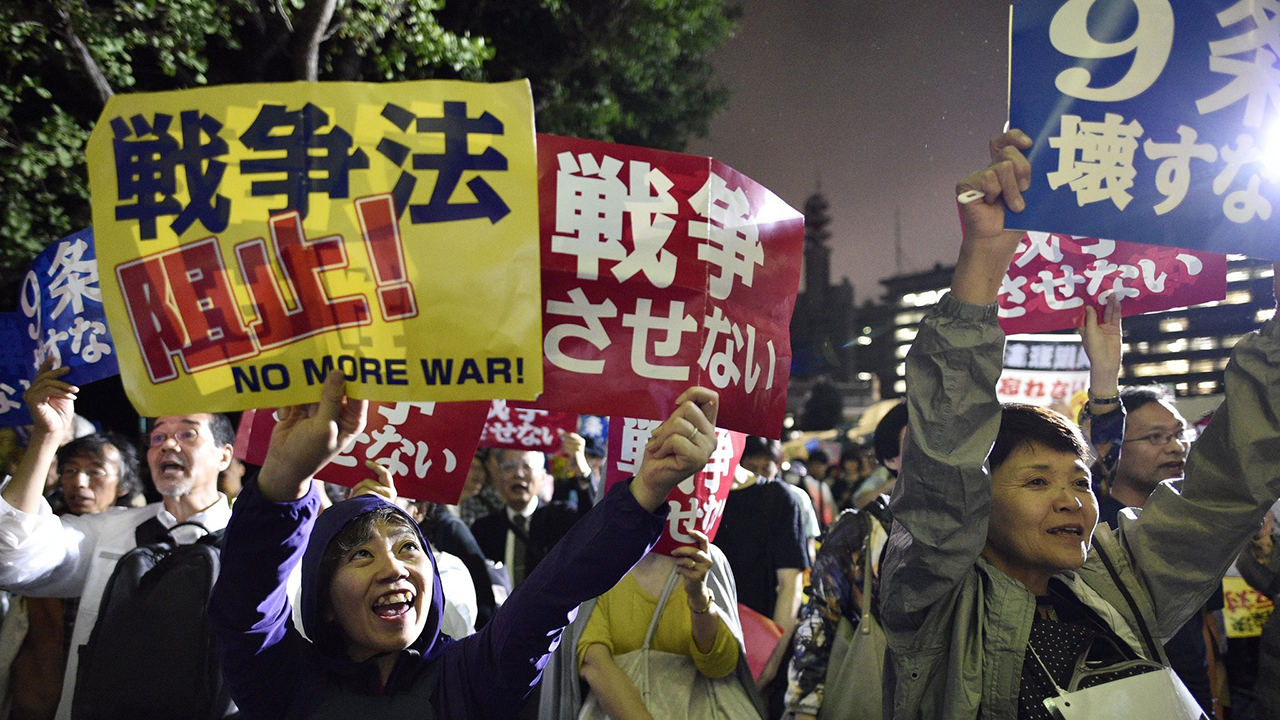
While protests in Japan seem rare, they do happen. Some in smaller numbers while others that are much larger. Protests regarding the U.S. military base in Okinawa has been an ongoing thing, the Narita airport protests by farmers who objected to having to give up/sell their ancestral lands for the runway constructions has been ongoing since 1966 (the Sanrizuka Struggle 三里塚闘争), while the anti-nuclear power ones drew considerable sized crowds after the 2011 triple disaster (earthquake, tsunami, and Daiichi Nuclear Power Plant meltdown).
Recently, protests have broke out (especially in Tokyo) against Prime Minister Takaichi’s remarks about using military force in Taiwan should a blockade by China take place (the protests were about the prime minister taking a pro-war stance which would also bring the country into wider conflict with China). Back in November 2025, several hundred protested in Okinawa.
Non self-defense military action is a very highly charged/sensitive topic issue in Japan given its past militarism which included war crimes across Asia. After Japan surrendered in 1945, its pacifist constitution (written in part by the United States) allowed for an armed forces that was in self-defense only. I have my own personal opinions on this because of the geopolitical realignment that is most likely going to happen (resulting from the U.S. becoming this unreliable partner where more countries are simply making their own partnerships with BRICS countries including China).
Japan’s constitution means it is heavily reliant on the U.S. for military support beyond that self-defense role. And that is a problem which isn’t easily solved unless Japan changes its constitution. That itself is full of potential issues because you need very competent and principled politicians to insure that the country will not go off into an uncontrolled offensively capable military. At the same time, Japan’s ability to self-govern itself completely in this rapidly changing world/geopolitics, represents a conundrum.
In March, additional protests took place in Tokyo to protest Takaichi’s visit to the United State to meet with the POTUS. The most recent protests have happened after the war in Iran escalated with 24,000 railing against the war and then just last week, 30,000 rallying outside the National Diet Building; besides the anti-war angle, both also were in protest of Takaichi’s February remarks about revising the Constitution (Article 9) which could allow the country to build up an offensive capable military.
With the ongoing blockade of the Strait of Hormuz, Takaichi has once again pushed the Constitutional overhaul angle. In light of the “civilization will end tonight” threat by the POTUS, this one now represents a serious catch-22. The U.S. has unserious/unqualified people in the chain of command. This includes a military that is being purged of qualified officers where actual operational damage is being done. Once the ranks of the U.S. military are filled with loyalists (ones no longer bound by international law and the rules of engagement), is Japan’s national security really going to be safe by being reliant on a partner that is no longer allied with the rest of free world?
At the same time, I have no idea as to what level of competence exists in this new right-leaning Japanese government (except that it is much more competent than what exists in Washington D.C.). I’m not sure if the average Japanese protesting this understands what exactly is happening in the U.S. either (and how that could be problematic for Japan if they do not gain a sembelance of their own autonomy from things written back in 1945 that may no longer be in the countries best interests (that includes being self-sufficient in terms of its own military capabilities while ensuring there are constraints in place to prevent a rogue leader from pushing Japan back into imperialism again). This topic isn’t an easy one given the current geopolitical climate and backsliding of democracy in the U.S.
In relation to the yet to be felt global energy shock, post-2011, nuclear power became a touchy issue in the country; 54 power plants went offline for inspections and to address safety issues (including ones that were covered up by falsified safety records). The country has been reliant on mainly fossil fuels with natural gas (34%) and coal (32%); various forms of renewable energy (solar, wind, and hydro) make up a much lower total percentages for its energy needs and as of 2024, only 10% was from nuclear via plants that were in operation.
With 2011 and the Daiichi nuclear power plant disaster fading in most peoples memories, the government has been looking to restart some of these long idle power plants again to being those energy prices back down. The largest (Kashiwazaki-Kariwa in Niigata) was restarted in January amidst protest by local residents. Now with this conflict in the Middle East, any competent leader of a country should have a clear understanding of the incoming global energy shock that is about to occur and the domino effect it will have on everything (price increases and shortages in materials and even food supplies). At that point, I can see the resistance to restarting more nuclear power plants falling away.
This obviously does not address fuel prices for vehicle and air transportation. I believe the latter (jet fuel costs) is about to get ugly and that is going to have that domino effect on the travel/tourism industry worldwide. I don’t mean to sound like a doomer… but this is what the situation is realistically looking like while most are kind of oblivious to just how bad things can get in the next several months.
Unfortunately, many regular people aren’t even paying attention (nor really have a solid grasp on the dominoes that will fall should this situation continue for several more weeks). It can end quickly if both Israel and the United States stopped their military aggressions in the region. The Israeli government has signaled they aren’t interested in that (their objective is genocide and annexing territories including that of neighboring Lebanon). The first diplomatic talks in years between the two countries in years is likely not going to be favorable for Lebanon (since everything is being brokered through the U.S. which itself is aligned and captured by Israeli interests).
The financial markets are in complete denial as well. Like this being one of them. I’ve read some really bad takes (that some of these moves are pricing in the conflict being settled real soon). And if the HFT algorithms are being dialed in to discount more of these ridiculous statements being put out by the POTUS, then all I can write at the moment is “look out below”. China has been very calculated and measured in their responses so far. But the potential for a misstep on the U.S. side with its military blockade does represent a potential for escalation.
Chinese president Xi Jinping did put out this statement though about the “global order crumbling into disarray” because he knows the global economy is about to go through some things which China has exposure to (basically, everyone gets hurt by this war that was started by both Israel and the United States while negotiating in bad faith from the very start).
The Japanese protesting this war is a good thing because everything happening in the Middle East, will eventually affect the country as well with higher prices. And that is a major problem for a country that has been wage stagnant for decades. The government needs to see/hear that people definitely do not want Japan to become involved in any part of that conflict. I could keep going on about this topic but my self-imposed time limits (on spending too much of it on politics/geopolitical issues) keep popping up.