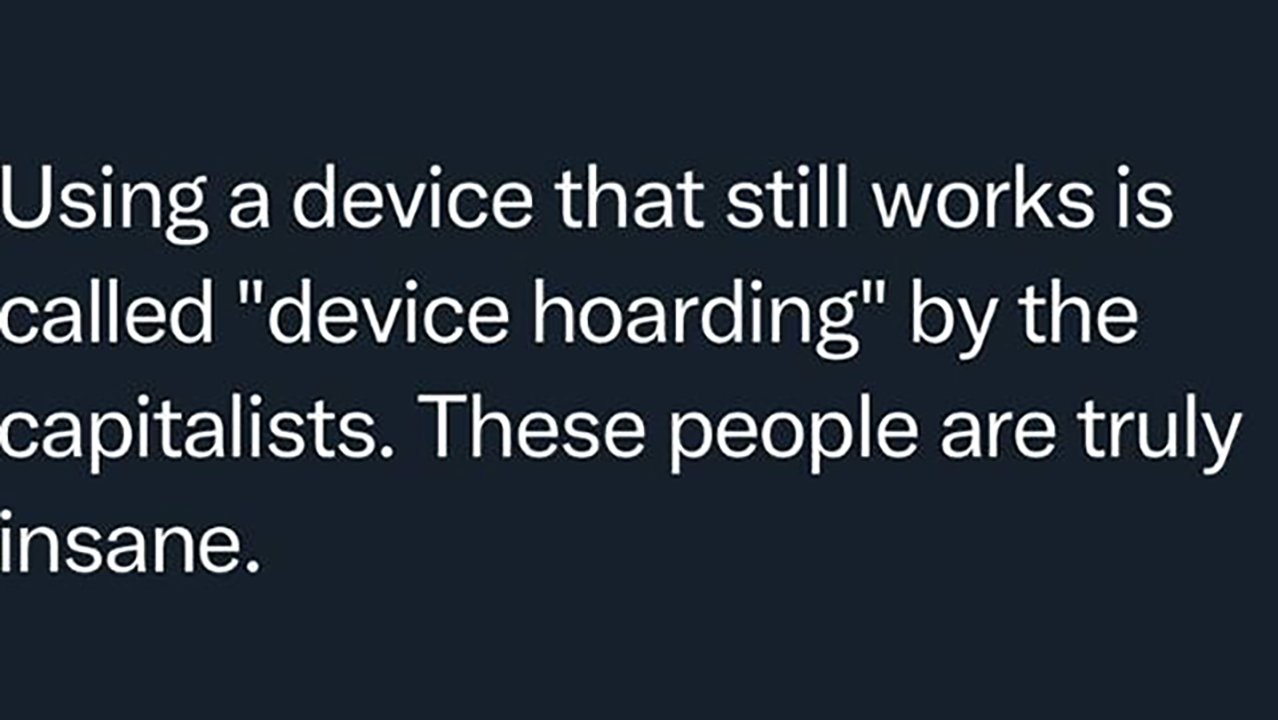
This was posted to CNBC back in November 2025 (one of the large number of draft posts I finally got around to finishing). Note the URL; the actual title of their post was modified from that to be less of a “rage bait” one. What’s important is the actual underlying message with how corporations and executives view this notion of consumerism (which also implies planned obsolescence) because at least with regards to Wall Street, consumer spending is a huge part of the numbers.
With what is happening in the Middle East, all of that is going to cause a drag on global economies because when those who have less disposable income to spend, discretionary spending (what consumerism relies heavily on) is going to take a large hit. And because economies are built on this number, “look out below” (as I always tend to say in situations like this). This is why I wrote about Wall Street being in denial when there is no rationality for the indices hitting these highs; well let me correct that — they may know so that the smart money is exiting positions (selling high to suckers that are buying into these rallies).
While this source is from 2024 (based on data collected in 2023), only the wealthiest 10% of American’s owned 93% of stocks while the bottom 50% of American’s held just 1%. And no doubt this percentage has continued to skew towards the top 1% since then. Translation: most of the wealth generation occurs in top 1-10% of the wealthiest people in the country. Rinse and repeat for other countries.
It’s long been part of the American propaganda (this message is driven by the financial markets for every sector that has a retail component by pushing degrees of spending onto the public). Black Friday is one of those and has expanding into sales like Cyber Monday. Discount retailers were just the precursors to this for physical brick and mortar stores (because who doesn’t like a discount?). Companies view your wallet and bank account as something to be “farmed”.
Tangent: Similarly, various forms of payment methods were created; anything which involves lending/credit, is an instrument that is used in consumerism because it is meant to get consumers to purchase items that cost more than what they could typically afford. Moving off the gold standard and allowing governments the ability to “print” money, requires an economy based around debt; banks after all need some sort of product for customers which they can generate revenues off of (that thing called interest rates for products like loans, mortgages, and lines of credit as well as all the different fees they’ve managed to add on over the years).
Those of us who have disposable/discretionary income have long used that system to work for us. For example, cash back rewards on a credit card works well when you pay off that balance every single time. Banks that offer any sort of line of credit which offers such rewards including interest free payments, absolutely despise consumers like myself that use such products for high ticket items, get that 2-5% cash reward back, and then pay off the balance (never giving them the interest). It’s why Goldman Sachs wanted out of their Apple Card deal (because a larger percentage of Apple Card holders tends to do exactly this). End tangent
As for “device hoarding”, using any product that is still functional and does what it needs to do, should not be defined this way as hoarding. It should be looked at as the environmentally right thing to do. But this always been the modus operandi of companies, especially with consumer electronics as more devices include firmware which can be updated. Many companies use that aspect as a means to “train” their customers with this notion of needing to upgrade due to security (it’s a perfect message which does have degrees of truth to it (especially for smart devices that that contain our digital lives).
Late stage capitalism’s “infinite growth at all costs” mandates selling product continuously to its customers. But maintaining that level of constant growth ends up hitting a wall without a form of planned obsolescence/designed life span). This is why companies lobby against “right to repair” initiatives or are pushing functionality as a subscription service in order to have that recurring revenue stream.
I view it as predatory behavior/practice though especially when some companies have the means to render a hardware product useless when they EOL the backend service it relies on to function. It also leads to this enshittification of product, services, platforms, and generally everything (the U.S. itself is a process of national decay being assisted openly by oligarchs and the political elite). This attempt to shove AI into every single corner of the globe is decay at a global level.
Apple has turned this “eventual obsolescence” of their own products into an art because their clockwork yearly operating system upgrade cycle (for effectively most all of their product lines), eventually moves hardware into a “vintage” category where the latest operating system will no longer run on that device. Changes to API’s can also effectively render older software non-functional or vice versa where newer versions of an app will only run on the latest operating system (and if your device can no longer be updated to that latest version, will require a hardware upgrade).
Apple of course has a very captive market (including ones who will upgrade their iPhone every year). There is obviously a scale involved depending on what device segment is being talked about. Like there will be much fewer people who will upgrade their iPad or Mac (desktop or laptop) with every iteration. My own iPhone cycle has normally been every 2-4 years; 4S -> 5S -> 6 Plus -> XR -> 14 -> 16 Pro. I later bought a 15 Pro (to replace my 14 which was my backup).
Some of this old hardware, I do end up giving away to those who I know will end up making good use of it. Similarly, some of the stuff I purchase to test, also ends up being given away. Like since I rarely used the M4 Pro Mac Mini and M3 Pro MacBook Pro (purchased to test specific local LLM workflows), I gave those away (thus I no longer have an Apple Silicon based Mac again and likely won’t unless there is a Mac Studio M5 Ultra that has enough GPU grunt to at least match/but preferably beat a higher end RTX 5 series).
I also gave away the DJI Osmo Action 5 Pro but am hanging on to the Action 6 for the time being. And while I was planning to trade in the Galaxy S25 Ultra when purchasing the Galaxy S26 Ultra, I ended up keeping it to do more Android <-> Android testing (but plan to also give it away once I am done with that). The only catch when doing this is I ask the recipients not to turn around and sell it/trade it in.
The point of doing this is in relation to the subject of this post; “paying it forward” to someone else who becomes the recipient of a perfectly usable device, means they themselves don’t have to put their money into the pockets of a company. My not trading it in means that a company (that would end up buying it at a fraction of what they plan to resell it at as a refurbished product), cannot remake margins on that used product. I just choose not to recoup my costs for it.
Finally, this statement telegraphs why sustained economic boycotts are very powerful tools that people can utilize when they are not happy with their political leaders. Companies lobby those politicians for favors. When their bottomline is impacted by consumers staying away from that spending treadmill, it incentivizes them to begin listening to regular people (the ones who are customers). I know this is oversimplifying things, but do keep this in mind as the Middle East conflict continues since all of that will eventually manifest itself in stagflation and recessionary pressures where all sorts of dominoes will be falling (including consumer spending).