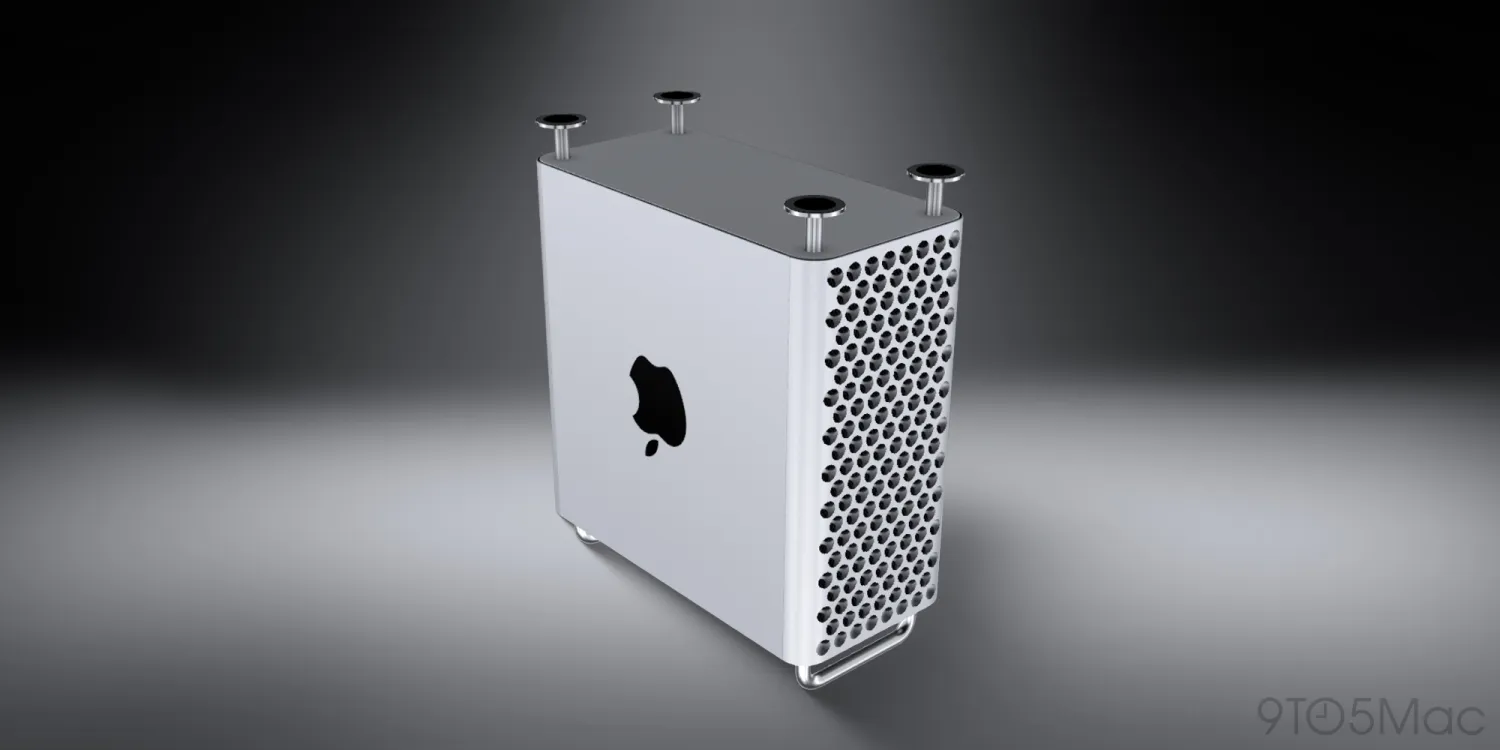
In the not so surprising move department, Apple has finally decided to discontinue/end of life (EOL) this desktop tower form factor (source: 9to5Mac) which due to Apple Silicon’s architecture (integrated unified memory, storage, and graphics with a lack of support for discrete GPU’s), reduced the benefits of this desktop tower design. It was last updated in 2023 as the first and only Apple Silicon variant of this product line (using the M2 Ultra). The upside down Mac Pro image by 9to5Mac (credit) above, was too good not to reuse.
The end of this form factor also represents the end of an era that began in March 1987 with the Mac II which had six NuBus expansion slots in them. My first Mac was the compact version of the Mac II (there was the IIcx and IIci which had three NuBus slots) purchased for the multimedia service bureau business I was starting up. I ended up outfitting it with what was then a state of the art Radius accelerated 24-bit graphics card and this DSP accelerator (whose name escapes me) which was used for hardware accelerating JPEG compression which at the time, was still fairly new (back then, encoding to/decoding from JPEG was a really processor intensive task; it would take at least 2-3 minutes to compress a 24-bit color 1024×768 pixel resolution image with just the processor).
Former Apple CEO John Sculley said it was the Mac II that really caused Mac sales to finally surpass the Apple II (the expandability part of the Mac II’s desktop form factor was the huge selling point). Ever since then, the Mac product line has had at least one form factor with expansion slots; the Quadra series, IIvi/vx, Centris, PowerPC 7×00/8×00, various Power Macintosh models (beginning with the 7200 NuBus was replaced by PCI); the Power Mac G3/G4/G5 with the exception of the G4 Cube, had PCI slots. The Mac Pro’s ending in March 2026 now closes off this chapter (coming full circle to that original internally non-expandable Mac).
Myself, I own the 2019 Mac Pro (based on the Intel Xeon architecture; Apple completely transitioned from Intel to Apple Silicon in 2023); for most general tasks, it is soundly beaten by most every Apple Silicon based Mac (there’s only a few specialized workflows which rely on GPU processing with the last higher end cards, where it does well). It’s an amazing design but one that no longer made sense with Apple Silicon. The only two Apple Silicon based systems I currently have are a MacBook Pro M3 Pro and Mac Mini M4 Pro (processor performance bound tasks are great but GPU related ones are ok).
For me, the internal expandability was one the major pros; the ability to stuff this box with RAM (ECC as well) and drive space, is where it will continue being relevant (since as I wrote before, I will end up using this for my virtual machines plus network storage).
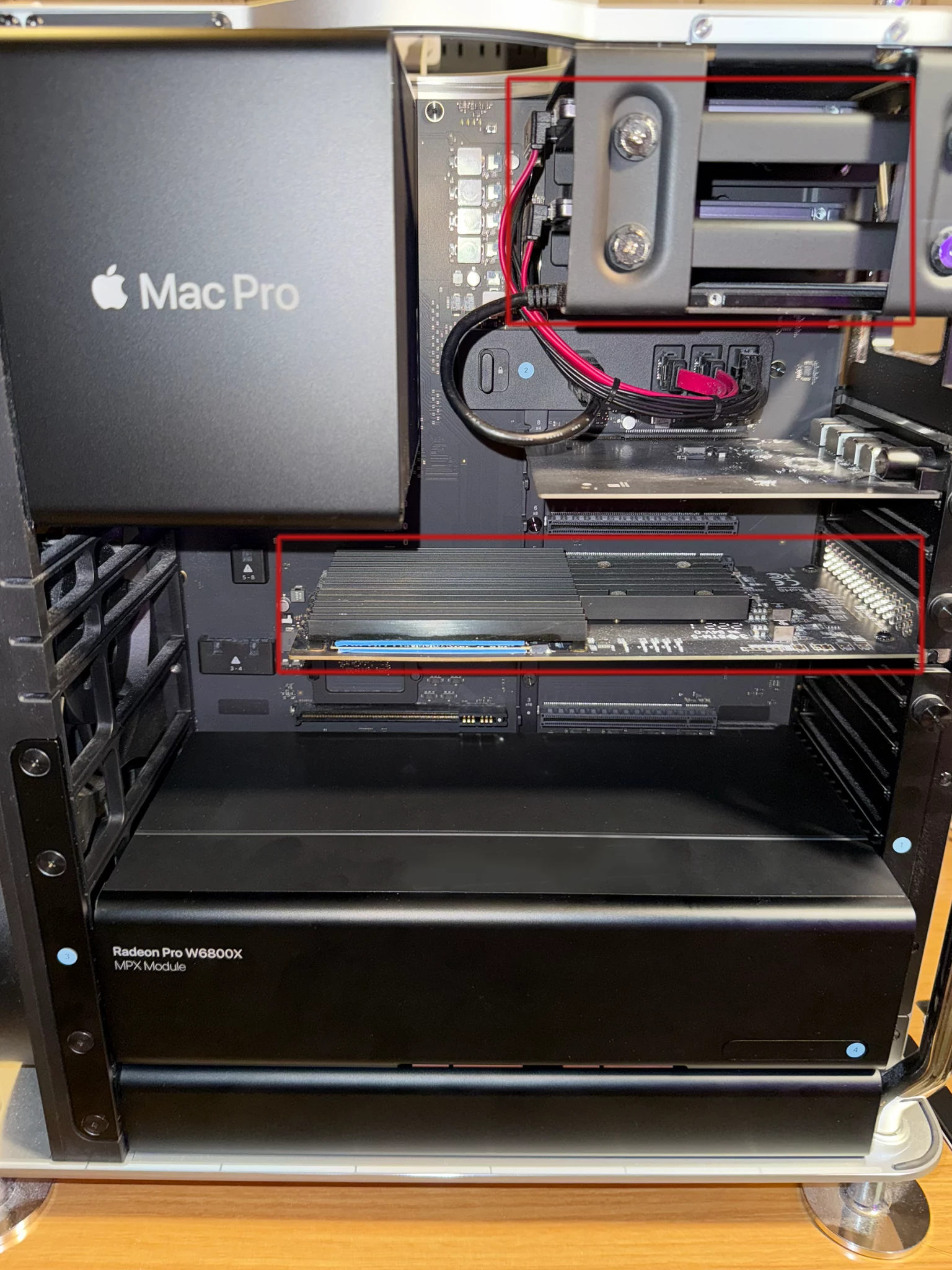
Both the Mac Mini and Mac Studio are now the primary desktop form factors where you BYOD (bring your own display) or for all-in-one, the iMac (which is a form factor I am not fond of). For those of us who prefer having as much stuff inside the case, Apple’s lineup going forward will require external chassis, dongles, and the mess of cables that tends to explode out of that (touched upon this in the past). Just because I worked for them in the past and am still invested (none of my sell orders have executed), doesn’t mean I hold back on criticism/highlighting areas I disagree with.
Many of us in this diminishing niche demographic of tower form factor users did wait patiently over the years including the period leading up to the 2019 revamp. Back then, Apple spent around 2 years redesigning the Mac Pro based on feedback and discussions with customers in several industries. While well engineered, Apple’s Apple Silicon transition announcement at WWDC 2020 just 6 months after the 2019 Mac Pro went on sale (December 2019), was the initial salvo that signaled the beginning of the end. The writing was on the wall with the architecture of Apple Silicon (non-upgradeable memory, restrictive internal SSD, and no discrete graphics card) and then the lack of updates to the Mac Pro since that Apple Silicon version in 2023.
Some customers had moved on after the 2013 “trashcan” style Mac Pro and were never going to come back anyway. Myself, I waited a few more years, then bought a certified refurb for the Intel version after the 2023 announcement/launch of the Apple Silicon Mac Pro (I highlighted the rationale for that here). In light of this EOL announcement, I definitely don’t disagree with my decision. It’s still a solid piece of hardware that I can use for Windows 10 LTSC or a mature Linux distro for Intel Macs if I ever decide to move completely away from macOS.
I know there are probably some who spent a lot for the 2019 model when it was new, and then went all in on the 2023 model, only to watch it languish (and now watching it being completely discontinued). No doubt, Apple will lose some of these loyal customers as a result (Apple however no longer really cares because they now have newer demographics of customers that have replaced us “fossils” that used to be the purchasing influencers — it’s just time doing its thing).
As I also mentioned before, over reliance on Apple does have its downsides because of how decisions are made as to what does/doesn’t get upgraded, how quickly technologies/API’s are depreciated, how their yearly operating system cycle has forced obsolescence built into it. Like the support for Intel-based application binaries running on Apple Silicon will end after Mac OS 27 (starting presumably with Mac OS 28) when Rosetta 2 is mostly depreciated.
We’ve been through this sort of transition/depreciation cycle before in the past with Rosetta in the PowerPC to Intel transition. The original 68K to PowerPC dynamic recompiler in classic Mac OS (which both Rosetta technologies are based on), was always kept in place (which is how Apple learned the lesson that some developers would never update their apps and would just rely on that legacy code). Many have had to go through the upgrade cycle with apps (not all were free updates in terms of the transition). Basically, there was often times a lot of cost involved in remaining a Mac user.
As for Rosetta 2, only a small subset of the framework will remain in order to support some older/unsupported games that still rely on Intel code. I’m presuming some still important titles from companies like Blizzard Entertainment that supported the Mac’s already then outdated implementation of OpenGL (which allowed them a level of cross platform development for titles like StarCraft 2, Diablo III, and World of Warcraft to run on Intel based Macs), are part of the reason why Apple isn’t completely depreciating support.
After Apple depreciated (that outdated version of) OpenGL in favor of their then incomplete version of Metal, Blizzard stepped away from releasing both Windows and Mac versions of their games; Overwatch, Overwatch 2 and Diablo IV are Windows only and despite Metal now being more mature + Apple’s game porting toolkit, Blizzard like many other larger studios are like thanks but no thanks – and I don’t blame them for historical reasons given how Apple has not been the most reliable partner when it comes to games that are more complex to develop; it’s why most of the major MMO’s were never released on Mac… not even miHoYo has bothered bringing their games like Genshin Impact or Honkai Star Rail over even though both are available on iPhone and iPad which shares that much more common lineage with Apple Silicon). The marketplace has spoken on this in terms of gaming beyond the simpler stuff that exists on the Mac app store (it’s why I ended up going back to dual platform a decade ago and buying PC’s for gaming).
Apple is relentless at leaving technology and compatibility behind (Mac OS 26 Tahoe is the last version that will support Intel based Macs; then after that, 3 years of security updates). Myself, I’m still on Monterey (12.7.6) as of this writing by choice. I was planning to upgrade to Tahoe, but heard others were running into degraded performance on these 2019 Mac Pro’s. I’ll probably at some point, upgrade to Sequoia (15.7.3) once I need the updated versions of a few software that requires at least Ventura (13.7.8). This lag time in updating isn’t new to me (plus I understand the potential security risks). But I’ve long been part of that resistance of obsoleting perfectly working apps that stop working with that operating system upgrade. And this is a thing Apple has got their customer base used to in the name of security updates (some of this can be mitigated with what you do online along with Little Snitch).
The irony isn’t lost on me either regarding how I had written years ago about possibly transitioning to an HP Z workstation like a Z8 G5 tower running Linux. With Apple officially discontinuing the Mac Pro, this does provide the clarity needed where something like an HP Z is back on the table. I guess what will depend is how much unified memory Apple can get the Mac Studio to (which will be bank account busting in terms of what they will charge) and what level of GPU performance (pushing the core count) where that part at least remains competitive with the higher end RTX 50 series (5080/5090). Note that I am just humoring myself here (see below).
At the same time, moving away from the Mac as my main system would have this “coming full circle” effect (since I originally came from that DOS based personal computer world and was an early user of Unix based operating systems). I’m also realistically at this part of my life where whatever next high end workstation (tower?) I settle on, will likely be my last (thus having upgrade options does count versus being locked into a fixed configuration (as would be the case with a Mac Studio).
As I’ve written before (in several of the above linked postings), while I’ve been mainly on the Mac for at least 3 decades now (then back to dual platform a decade ago where that PC was mainly for gaming), it’s not a very sticky one in terms of the ecosystem (my Mac’s aren’t tied heavily to iCloud by conscious choice and none of my devices uses iCloud Photos which is one of the key iCloud features that ties a users devices into that ecosystem).
A lot of the machine learning based stuff (with local models) I am using, most of the heavy lifting is done on my gaming PC since it has an RTX 4070Ti SUPER that just ran rings around my M4 Pro Mini where under load, had the fans ramped up (I’d need to move to a higher end Mac Studio for that better GPU performance but it would be a cheaper/better option to just get an RTX 5080 — again, performance per watt is something I care less about on a desktop).
Physics and thermal dynamics are still a thing; towers are that size for a reason (thermal cooling). The Mac Studio form factor still places a limit in this area (because heat will still build up in that smaller volume of space) but unlike the 2013 Mac Pro (Intel), Apple Silicon is by design, very good with performance per watt (by their original mobile focused design) and thus can run within that case without running into a thermal dead end at a power level that provides processing capabilities that exceeds other chips.
That is unless the competition manages something similar (where Apple would find itself backed into a thermal dead end again). Historically speaking, the competition doesn’t sit still. It occasionally screws up (like Intel has in recent years). No one knows if they’ll get themselves back into the position they used to have or really come up with tech that gives Apple Silicon a run. But if they or AMD do put out such tech, former loyal customers aren’t going to necessarily stick around like they did in the past (for myself, that went out the door a while ago not only for Apple, but many other brands across industries).
If there weren’t these self-imposed (by form factor design) thermal constraints and if Apple ever saw it fit to compete in that raw performance workstation/server market (which has normally been tepid even during the time I was there), Apple Silicon would be formidable; Apple as a company just isn’t interested in that market which makes customers like myself, the odd folks out who would be better served by something like the above mentioned HP Z8. I didn’t even touch upon the I/O constraints when it comes to PCIe lanes and total bandwidth. Again, Apple doesn’t care about the higher end of this workstation market (nothing wrong with that).
Customers who need error correction code memory will no longer have an option for that with Apple (Mac Studio doesn’t solve this since its unified memory isn’t ECC). Again, this is a smaller demographic that has those strict requirements of data integrity. Apple as a whole isn’t really a player in those sort of mission critical operations; they are just making it even clearer now that this higher end workstation market isn’t something they are interested in continuing to pursue (not too different from when they got out of both OS X Server and Xserve).
Apple killing off the Mac Pro is the much needed telegraph telling the smaller demographic of dinosaurs (self included), that our business isn’t needed. And I get that because Apple makes it up many times over in those other segments. It is what it is (and from just reading some of the comments on the AppleInsider and MacRumors forums, lot of folks in this demographic knew this was inevitable). 1987-2026 was a good run for internally expandable Mac’s (too bad it missed 40 years and making it past the 50th anniversary of the company in a few days).