
15 years ago on March 11, 2011 at 2:46PM JST, a magnitude 9.0 undersea megathrust earthquake occurred in the Pacific Ocean, 72 km/45 miles east of the Oshika Peninsula of the northeastern (Tohoku) region on Honshu Island. The initial reported magnitude was around an M7.9 and was slowly upgraded to M8.4, M8.8, and then M9.0/9.1 as more data and calculations were made over the course of the hours that followed. Often times shortened to 3.11, each year is marked by solemn remembrances and a moment of silence (with some locations still sounding the alarms).
For those in the Tohoku region, they experienced the most intense ground shaking (seismic intensity of Shindo 6-7). Myself, I was living in Tokyo at the time and was at my office in Shinjuku in a moderate height tower (Shinjuku NS Building). We knew it was bad when the tremor kept increasing in intensity. The initial “P” wave sent that soundwave frequency that I could feel reverberate/bounce around from inside my body.
The quake itself lasted for 6 minutes. For many, the feeling and sounds of that Friday afternoon hasn’t been forgotten by those who experienced it. While this was one of the most captured seismic events, the videos really do not convey the sensory overload from the intense ground movements and the sounds (and soundwaves that penetrate your core) that comprise the peak of those 6 minutes.
Japan has several seismic experience centers (including simulations that replicate the Shindo 7 shaking during the 2011 earthquake) including Bosaikan in Ikebukuro (reservations required) and the Tokyo Rinkai Park Disaster Prevention Park in Odaiba (near the Ariake Arena/Tokyo Garden). Both do not charge an entrance fee.
Kitakyushu City recently introduced (fall of 2025) an earthquake experience vehicle which similarly allows simulation of a Shindo 7 temblor. Younger people who have not had direct experience with the Great East Japan Earthquake, were able to get a feel for that last fall. While many have seen videos, experiencing a simulation of the shaking turned out to be even more intense than they expected while reinforcing the need to be prepared/understanding evacuation routes and shelter locations. The students also learned life-saving techniques including how to transport injured people.
What these simulators can’t really do is impart the actual situational reality where anything that isn’t nailed down or the structure that you are in, becoming a potential object that can cause injuries. A part of your brain still knows it is a controlled environment unlike during an actual large scale earthquake where all of your senses go into high alert/fight or flight mode.
Tokyo experienced a seismic intensity of 5. The majority of skyscrapers in Tokyo are on seismic isolators and dampening systems. This also means the ground motion can cause them to sway/rock back and forth for long periods of time with the upper floors really magnifying that swaying. This remains one of the most unsettling quakes I’ve experienced where it felt like controlled chaos.
Rail lines were shutdown (many walked to get back home), vehicular traffic snarled, mobile networks overloaded, and long lines at the dwindling number of pay phones. I naturally didn’t have my actual video cam with me (and hadn’t bought an actual smartphone yet; this was around the time of the iPhone 4). Thus the short trash quality video (plus it was wiser to get under a desk).
After we got the all clear sign to evacuate the building (most skyscrapers including the one I was in were rocking from the seismic stabilizers for over 20 minutes), headed back east towards Shinjuku Station stopping first near the Studio Alta video display playing the news broadcast from NHK.
Yunika Building just a short walk away, has much larger displays so headed there and watched NHK News playing live feeds of the major tsunami that was now hitting/engulfing the coastal areas of Tohoku (so many of us were just stunned watching these events unfold in real time). Archive of the original NHK broadcasts.
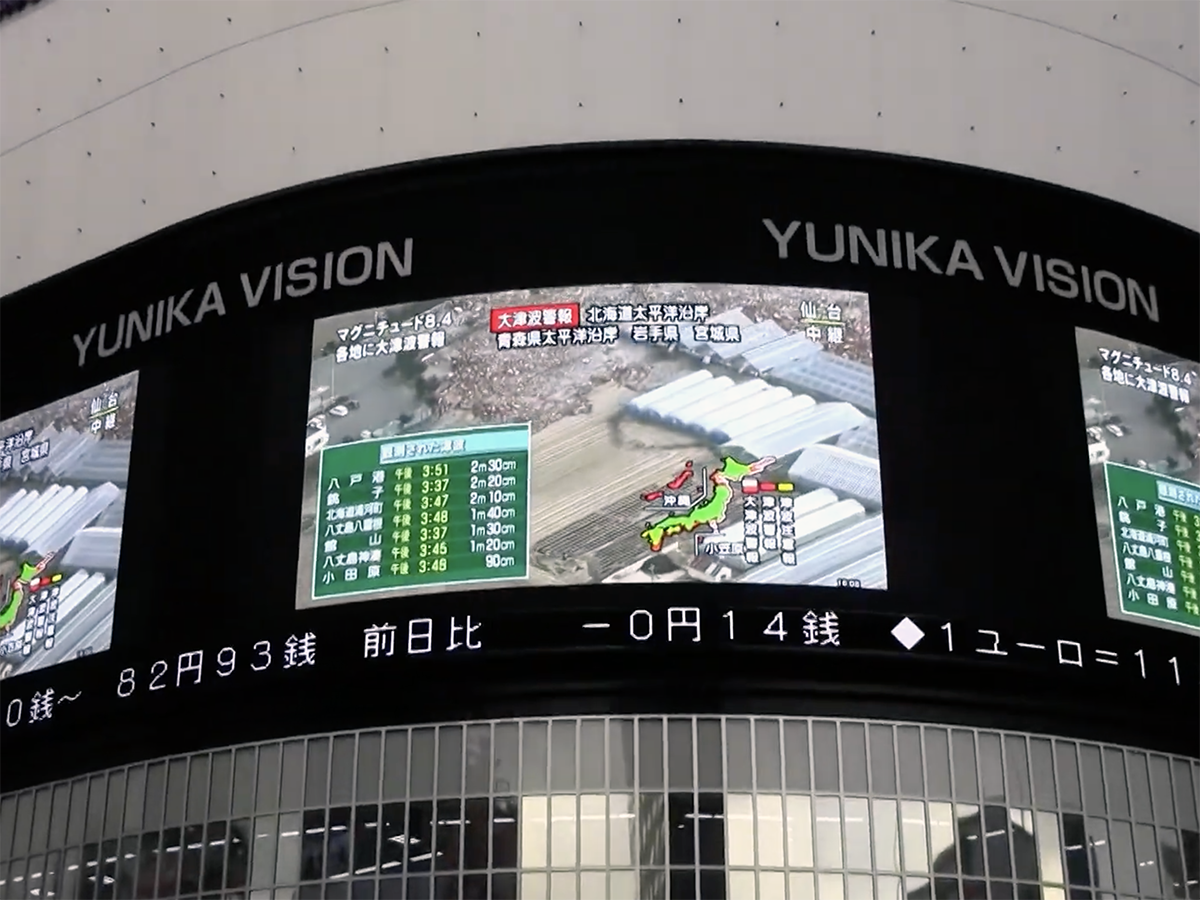
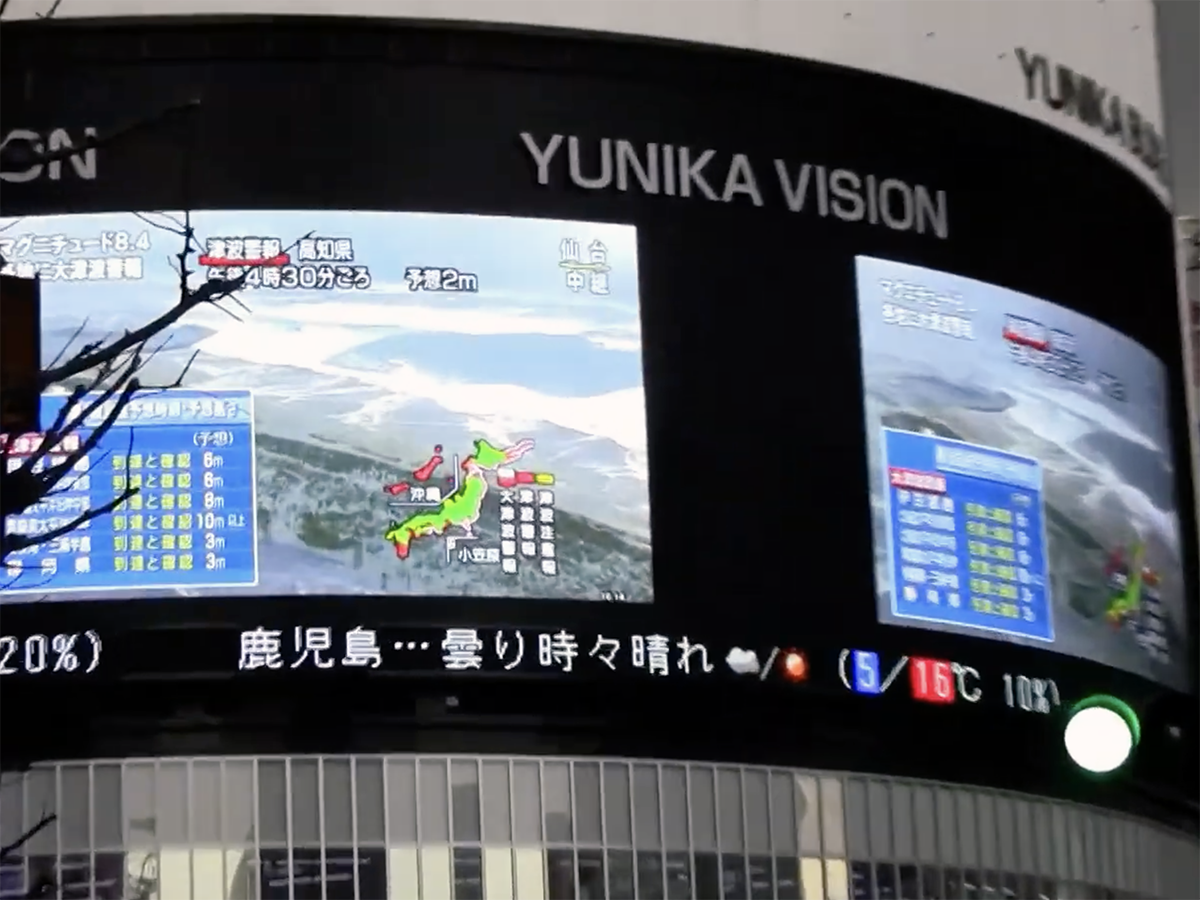
The following is a recent compilation that only visualizes a small part of the chaos of 3.11 described above (timestamps better described here)
After this, the media portal I was running ended up being dedicated mostly to this disaster (but eventually stopped running it after 10 years in service because since 2011, I felt like it was taking a mental toll after reviewing countless hours of footage as more of it was released/uploaded and learning about failures caused by bureaucracy and miscommunication). I ended up creating one of the earlier archives of 2011 earthquake and tsunami videos (that others eventually replicated/expanded on YouTube).
An year later, a bunch of us traveled to the region to take part in some volunteer efforts and to attend the first year remembrance. I wrote the following regarding Sendai Airport, Yuriage and Ofunato (the Yuriage writeup was the longest since it also tied into a documentation that NHK released). There is one word to describe it; sobering. What happens is you end up replaying the actual events experienced that day (and then the weeks after) from your personal point of view, recalling the imagery seen on broadcasts and from the archive of personally shot video, then piece it all together when seeing some of those places with your own eyes (with some of the debris cleared and other spots, still untouched).
Asahi News has been capturing some of this progress in various locations since 2011 until the present (following is a playlist; lot of the ones documenting the changes since 2011 are at least 30+ videos in).
One project that also sprung out of this disaster was Sakura Line 311 (EN). Their goal since October 2011 has been to plant a line of 17,000 sakura (aka cherry blossoms) along the coastal areas that were devastated by the tsunami with the goal of passing down the memory of that disaster (the line of trees is meant to highlight areas that should be avoided in the event of a tsunami warning). I’ve been donating to this organization every year and recently, began running an online western fundraising campaign via Tiltify since 2025 (QR code below).

There are also some pilgrimage routes for cycling and driving; one of the main ones that link together different disaster memorials is 3.11 Densho Road (where the overarching theme is “lessons save lives”). In many places, reminders of the disaster have been preserved as facilities that are meant to serve as reminders and lessons for the future. There were also other locations where residents decided to have everything removed because they did not want to be constantly reminded. It’s safe to say that as time has passed, more have forgotten about 2011 (though the megaquake advisory in 2024, did help bring some of it back into memory again).
It’s hard (and not hard) to believe that time has flown so quickly. 15 years later, many areas are still in the reconstruction phase. Some residents have chosen to rebuild their lives elsewhere while others have passed on in the subsequent years. Others are still hoping to be able to resume their lives in their hometowns once again. Whether ahead of, on March 11th, 2026, or after, may all those who were lost, rest in peace.
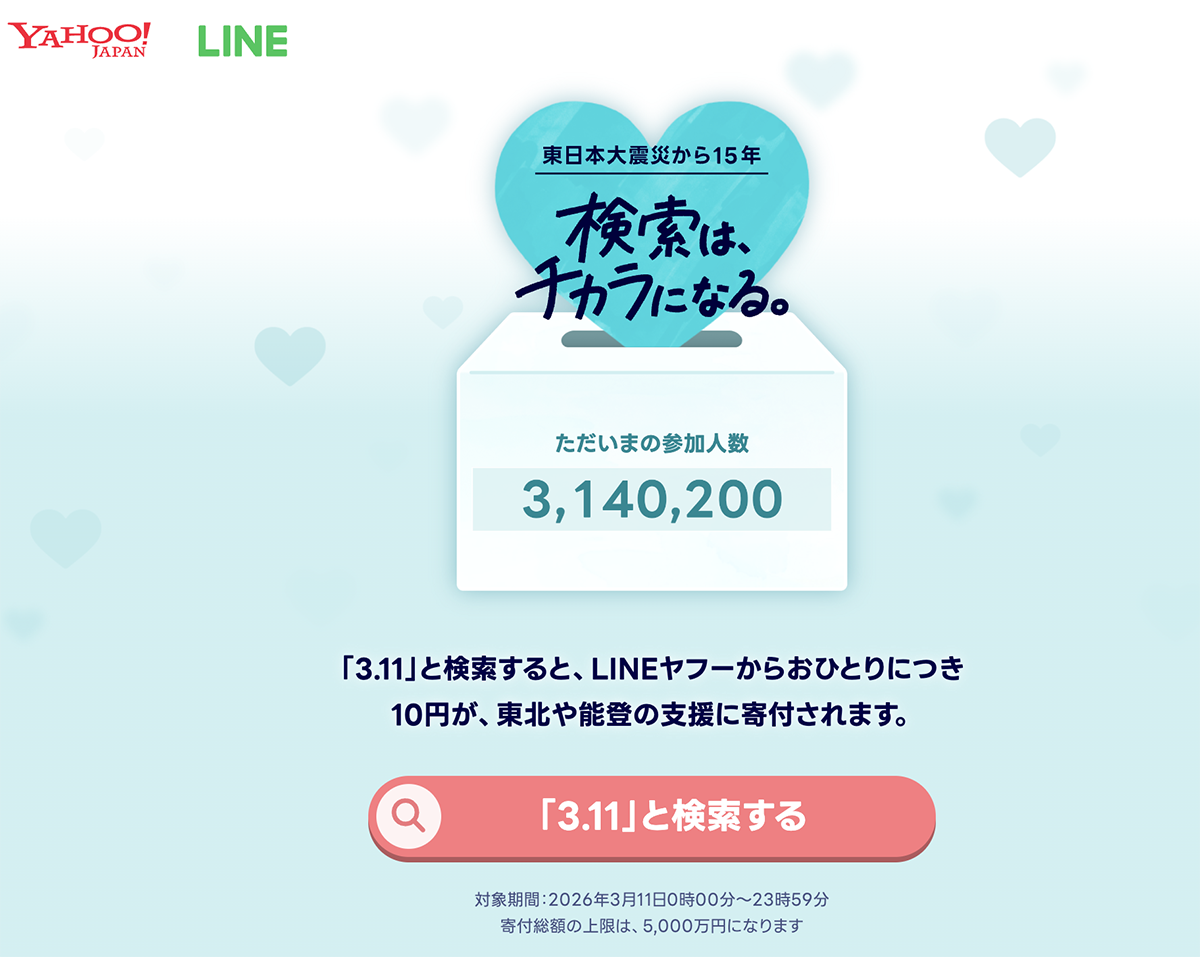
Yahoo! Japan in conjunction with LINE, are donating ¥10 for each person who performs a search with “3.11” (on either Yahoo! Japan or LINE) on 3.11.2026 from midnight until 23:59 JST (ENDED).